
BY MISHI GONGO
Electric tuk-tuks are giving Coast transport operators relief from high fuel costs and offering passengers quieter, more comfortable rides. But unreliable electricity, infrastructure and costly spare parts threaten to slow the region’s green transport transition.
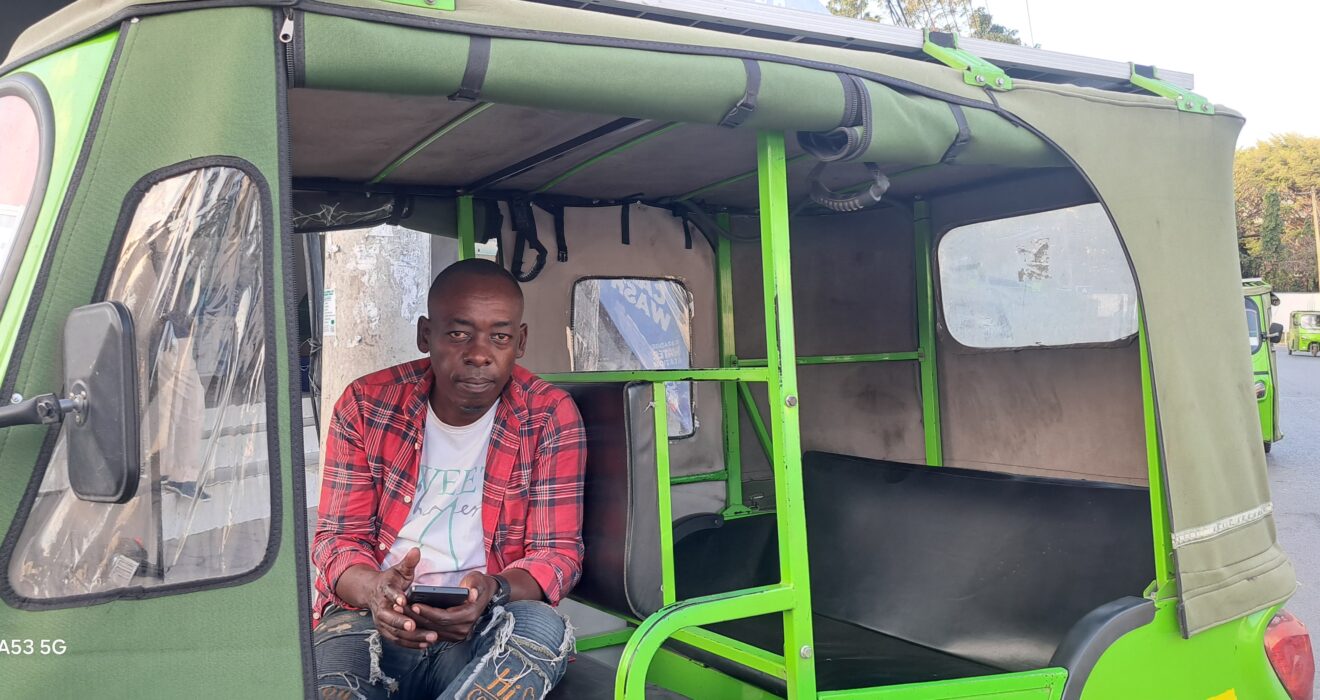
At 6am, before Mombasa’s streets begin filling with commuters and tourists, Mr Nyangate Eric drives his electric tuk-tuk to a battery-swapping station.
It is a routine he has followed for the past year.
But unlike the days when he operated a fuel-powered tuk-tuk, Mr Nyangate no longer starts his morning by checking the fuel gauge.
He checks his battery.
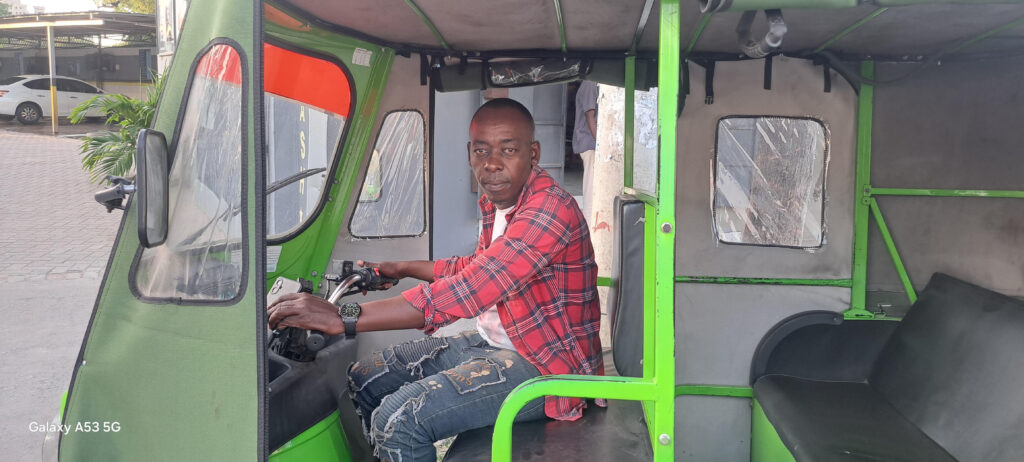
“Fuel used to take Sh1,200 from my pocket every day. Now I spend about Sh300 to charge,” he says.
Instead of waiting for the vehicle to charge, Nyangate exchanges a depleted battery for a fully charged one, allowing him to get back on the road within minutes.
For the tuk-tuk operator, the switch has brought one major relief, fuel prices no longer dictate how much of his daily earnings disappear before he goes home.
On a good day, his fuel-powered tuk-tuk would earn him about Sh2,500, meaning almost half of that income could go towards fuel.
His electric tuk-tuk has also given him more capacity. It carries five passengers compared with the three carried by his previous vehicle.
But the savings come with a catch. The vehicle may not need petrol, but it still needs something just as essential,reliable electricity.
And when there is prolonged power outage, Mr Nyangate’s livelihood can come to a standstill.
“When the power goes off for long, the tuk-tuk has to stay parked. No power means no work,” he says.
This is the dilemma increasingly confronting transport operators along the Kenyan Coast as electric tuk-tuks and motorcycles begin appearing alongside the thousands of petrol-powered vehicles that have long dominated the region’s roads.
The shift promises quieter journeys, lower running costs and potentially fewer transport-related emissions. But it also raises an uncomfortable question, Can the Coast’s infrastructure support the green transport revolution it is beginning to embrace?
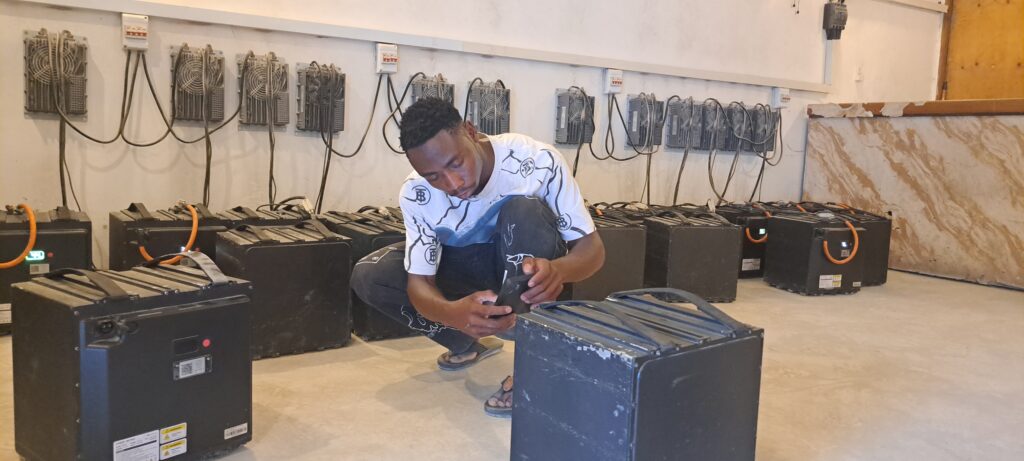
In Mombasa and across the Coast, transport operators are experimenting with a different way of powering their livelihoods.
In Kwale County, electric tuk-tuks are becoming increasingly common, with operators pointing to high fuel costs and the limited availability of conventional fuelling stations in some areas as reasons for making the switch.
Mr Ali Mwakujenga, a tuk-tuk operator in Kwale, says passengers are also helping drive the change.
“Passengers are warming up to them, and the market is good,” he says.
South Coast chairman of tuk tuk operators Mr Chimera Mwamunga said they have no challenge with the swapping stations but are forced to stop operations when there is prolonged power outage.

For passengers, the appeal goes beyond the price of the journey.
Ms Aisha Hassan, a passenger in Mombasa, says she prefers electric tuk-tuks because of their comfort, quietness and additional space.
“The ride is quieter, more comfortable and spacious,” she says.
Ms Aisha says she prefers electric tuk tuks even though they charge the same fare as the fuel ones.
“Even if the electric ones start to charge more i will still pick them due to their comfort, “she said.
For Mr Nyangate, however, the attraction is more immediate.
It is the money saved at the end of every working day.
His electric tuk-tuk costs about Sh385,000, compared with approximately Sh500,000 for a fuel-powered model, he says.
The running costs are also lower.
A full battery can take him about 120 kilometres before it needs to be swapped, according to Mr Nyangate.
Charging an empty battery costs about Sh550. If the battery is between 50 and 30 per cent, charging costs about Sh150, while charging when it falls below 30 per cent costs about Sh300.
The savings are significant.
But so is the risk.
For a petrol-powered tuk-tuk driver, an empty tank can mean a quick stop at a fuel station.
For an electric operator, an empty battery can mean waiting.
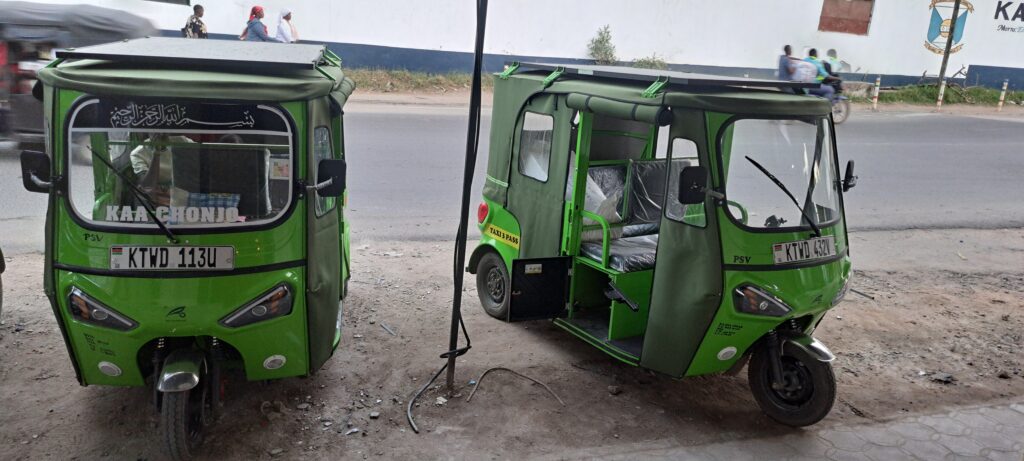
Mr Nyangate says a completely depleted battery takes at least two hours to fully charge.
And sometimes, even reaching a charging station does not guarantee an immediate return to the road.
Operators can arrive and find that the available batteries are not fully charged, he says.
Every minute spent waiting is time that could have been spent carrying passengers.
Every hour off the road is money lost.
The problem becomes even more complicated when an operator wants to travel outside familiar routes.
“Travelling to another county is tricky. You can get there and wonder, ‘Where will I charge this thing?’” says Nyangate.
It is a question that exposes one of the biggest obstacles to electric mobility on the Coast.
The vehicles can travel, but the charging network must travel with them.
Without adequate charging and battery-swapping points, the freedom offered by an electric tuk-tuk can quickly become limited by geography.
Mr Athman Haji who operates in Kilifi County is one of them.
“I am used to this one, it have operated it for more than two decades. I know when it needs service, I know when the engine has a problem, getting an electric one means learning afresh, “He said.
He also raised concern over the location of swapping stations.
“Unlike the petrol stations where they have ample space for parking, some swapping stations lack that. Others are not easily accessible, “he said.
Mr Nyangate has also noticed another difference in his day-to-day experience.
He says the battery tends to last longer when the sun is out compared with rainy days.
Even with all the benefits there are still operators who will not trade their fuel tuk-tuks to the electric ones.
That means the weather can influence how far he can travel before needing another charge or battery swap.
For an operator whose income depends on the number of trips completed each day, such uncertainties matter.
The same is true of electricity outages.
An electric tuk-tuk may free a driver from the volatility of petrol prices, but it creates a new dependence, the electricity grid.
That raises a broader climate question.
If the Coast is going to replace thousands of fossil-fuel-powered vehicles with electric ones, will charging infrastructure and electricity supply be able to keep pace?
Kenya’s move towards electric mobility is part of a broader effort to reduce dependence on fossil fuels and cut emissions from transport.
The National Electric Mobility Policy launched in February 2026 places cleaner transport, charging infrastructure and low-carbon development at the centre of the country’s transition.
According to Kenya Institute for Public Policy Research and Analysis Fossil fuel vehicles in Kenya account for about 13 to 17 percent of the country’s total greenhouse gas emissions.
Road transport in Kenya emitted about 12.34 million metric tons of carbon dioxide equivalent (MtCO₂e) recently, up from 7.74 MtCO₂e.
Emissions from the transport sector are projected to grow to 17 percent of total national emissions by 2030 due to more vehicles on the road.
This however can be countered if the country succeed in adopting e mobility.
In May this year while addressing the press in Mombasa President William Ruto announced that the government has ordered 3,000 electric vehicles for use by security and administration officials as part of efforts to reduce dependence on fuel.
The President said the move forms part of broader government efforts to transition the country towards cleaner and more affordable energy alternatives while reducing pressure caused by fluctuating global petroleum prices.
But on the Coast, the green transition is not necessarily being driven by climate concerns.
For many operators, it starts with the cost of doing business.
The calculation is simple, how much can I save?
For Nyangate, the answer is clear.
A reduction from about Sh1,200 a day in fuel costs to about Sh300 for charging represents money that can instead go towards food, school fees, rent or other household needs.
The climate benefit may be important, but the immediate benefit is economic.
That presents both an opportunity and a challenge.
If electric transport is cheaper to operate, more drivers could be persuaded to make the switch.
But if spare parts remain expensive, charging points remain limited and electricity supply remains unreliable, the transition could struggle to move beyond early adopters.
The electric tuk-tuk may eliminate petrol from the equation, but it has not eliminated expenses.
Mr Nyangate says spare parts for the newer vehicles are costly.
This presents a new challenge for an industry accustomed to conventional engines and mechanics.
The transition therefore requires more than putting electric vehicles on the road.
It requires mechanics with the skills to repair them, businesses able to supply spare parts and charging networks capable of supporting operators throughout their working day.
There is also the question of what happens to the batteries when they reach the end of their useful life,an issue that will become increasingly important as Kenya’s electric fleet grows.
For the Coast, therefore, the green transport revolution is a race between adoption and preparedness.
Operators are already making the switch.
Passengers are embracing the quieter rides.
But the infrastructure supporting the transition must catch up.
Back at the swapping station, Mr Nyangate waits for his battery.
Soon, he will be back on Mombasa’s roads, carrying passengers and trying to make enough money to take home at the end of the day.
His reasons for switching were not complicated.
He wanted to spend less money on fuel.
But his electric tuk-tuk has placed him at the centre of a much bigger experiment one in which the Coast is beginning to test whether cleaner transport can work not just as a climate solution, but as a livelihood.
For Mr Nyangate, the future is electric.
But that future still depends on something beyond the vehicle itself.
There must be power to charge it, stations to support it, spare parts to repair it and infrastructure to allow it to travel beyond familiar roads.
The Coast has started moving away from the fuel pump.
The question now is whether the charging network can keep the wheels turning.