
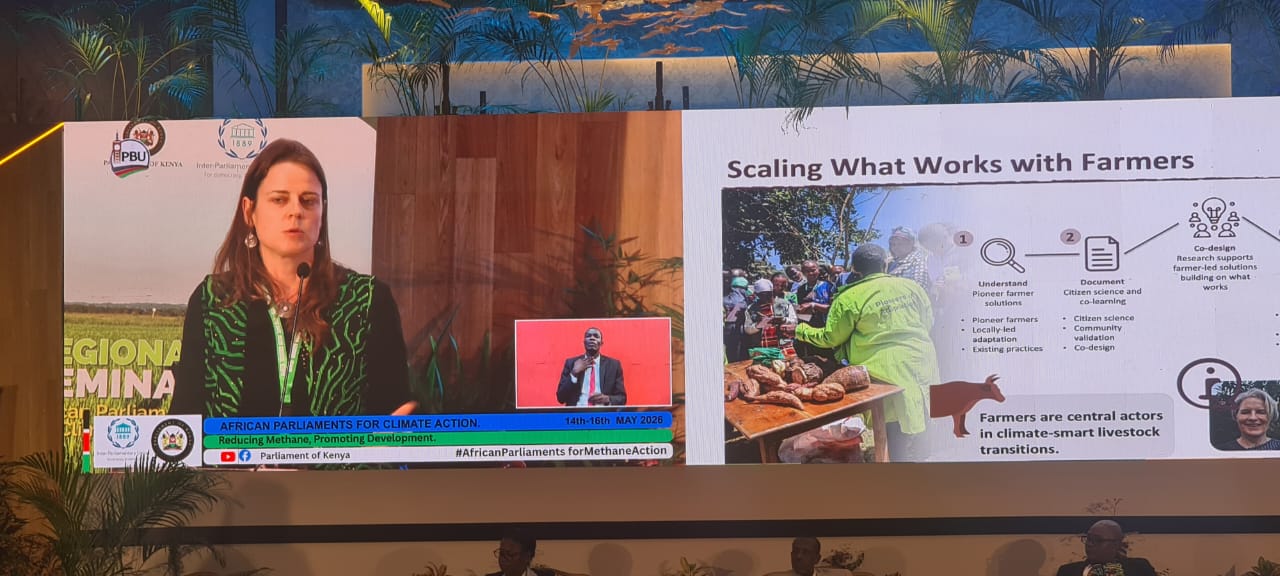
Cover Photo:Dr Claudia Arndt, Senior Scientist and Team Leader of the Mazingira Centre at the International Livestock Research Institute (ILRI) in Nairobi, presents her paper during a session titled “Agricultural Systems and Methane in Africa”.
BY MARICUS AGUTU,
Maricus.agutu@greencommsinstitute.org
African parliamentarians have underscored the need for urgent, collective action in taming methane emissions, describing the phenomenon as a major contributor to global warming and a driver of climate change impacts across the continent.
The legislators, who were attending a two-day conference on methane emissions and climate action in Nairobi, Kenya, made a resounding pitch for practical steps to lower emission of methane – a potent greenhouse gas released from sources such as livestock digestion, decomposing waste, manure management, rice cultivation, fossil fuel extraction and wetlands.
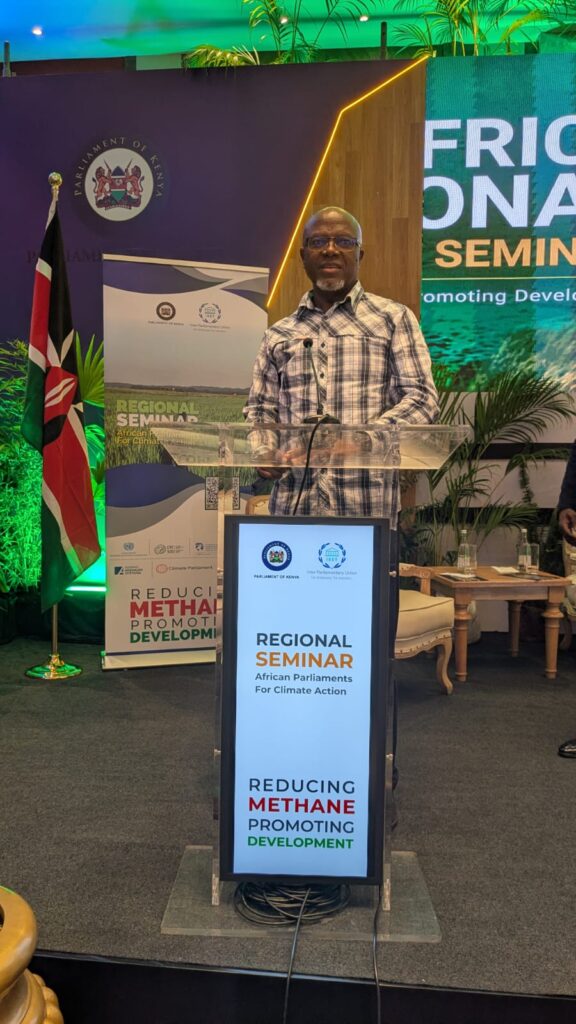
They further called on African parliaments, governments and regional institutions to promote a strong and united African voice in global climate and methane-related negotiations. This would also ensure that international frameworks, financing mechanisms and policy approaches fully reflect Africa’s development priorities, food security needs and national circumstances;
The event was co-hosted by the Parliament of Kenya and the Inter-Parliamentary Union (IPU), in cooperation with Climate Parliament, the Climate Vulnerable Forum, the United Nations Environment Programme, the Climate and Clean Air Coalition, International Livestock Research Institute, World Agroforestry Centre and the Stockholm Environment Institute, among other institutions.
The conference who theme was “African parliamentarians for climate action: Reducing methane, promoting development”, brought together members of Parliaments from across Africa and prominent parliamentary groupings such as PAP and IPU.
Scientists, researchers and climate experts took turns at the event dissecting the subject and helping participants and delegates have a better grasp of the matter of methane emissions and its centrality in the continent’s climate agenda.
According to the experts, although methane remains in the atmosphere for a shorter period than carbon dioxide, it is significantly more powerful in trapping heat. Scientists estimate that methane is over 80 times more potent than carbon dioxide over a twenty-year period. This makes methane reduction one of the fastest and most effective strategies available for slowing global warming in the near term.
In their joint communique at the end of the conference on Saturday, the legislators were categorical that climate change was already severely affecting countries across Africa impacting livelihoods, ways of life, food systems, health and economic development, with vulnerable groups facing the most severe consequences, and that addressing these challenges urgently requires integrated and context-specific responses.
“Methane is a powerful greenhouse gas with a significant short-term warming effect. Emissions from the agriculture, waste and energy sectors contribute to climate change while also affecting air quality and public health,” they noted.
Reducing methane emissions can, therefore, deliver short-term climate benefits while supporting improved health outcomes and economic opportunities, they noted while acknowledging the diversity of national circumstances across African countries, including differences in emissions profiles, development priorities and institutional capacities, and consequently the importance of tailoring approaches accordingly.
The leaders emphasized the importance of global inter-parliamentary cooperation and solidarity in addressing climate change and methane emissions, with a view to promoting knowledge exchange, strengthening policy frameworks, reducing emissions and mitigating impacts on the most vulnerable populations.
They urged African states to prioritise implementation of existing international frameworks and initiatives, including the Paris Agreement and the Global Methane Pledge, whose objectives are to limit global temperature increase and reduce methane emissions.
The conference recognised that methane emissions are a global challenge requiring collective action. All countries were, therefore, encouraged to act in line with their national circumstances and development priorities, to consider opportunities to reduce methane emissions as part of their broader climate and sustainable development efforts.
In their comments, the MPs welcome the engagement and exchange of experiences and practices among parliaments during the seminar, including on the role of legislation, budget oversight and parliamentary engagement in advancing climate and methane action. This demonstrates the growing interest in strengthening parliamentary engagement on methane and climate action,
They emphasised the importance of addressing methane emissions in key sectors discussed during the seminar, including agriculture, waste management and energy systems, in ways that also support food security, access to services and sustainable development,
Efforts to address methane emissions in Africa support food security, resilient livelihoods and sustainable development, must be upscaled while opportunities that methane abatement actions can bring for innovation, productivity improvements, resilience and locally appropriate sustainable development approaches, are exploited.
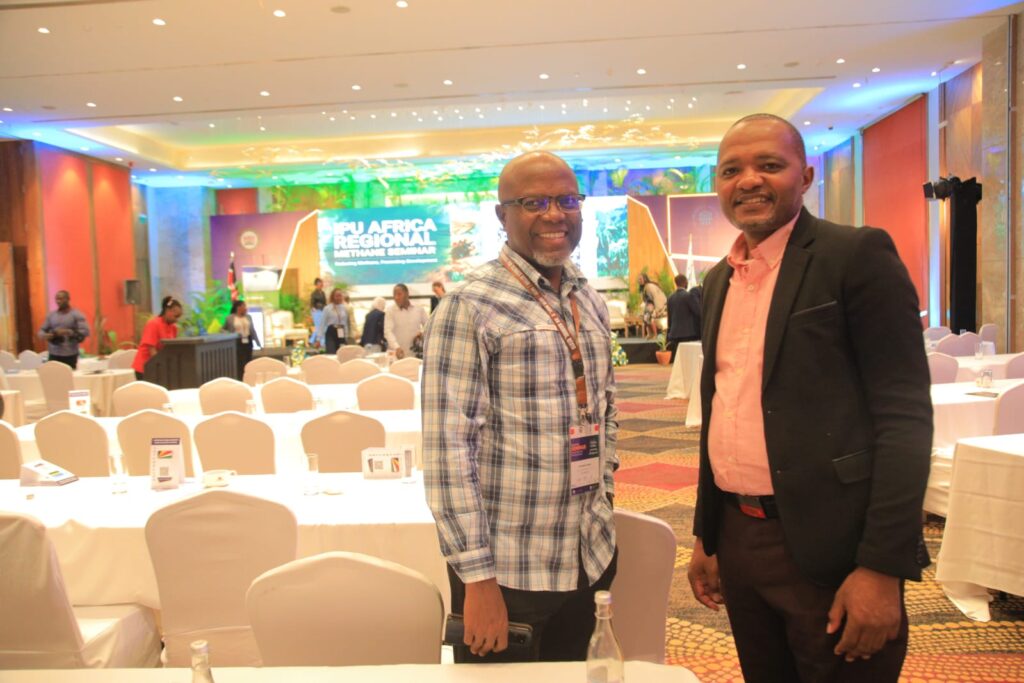
Regarding the role of national parliaments and continent-wide parliamentary bodies in this initiative, the legislators undertook to:
- Promote informed and inclusive policy development on climate and methane action.
- Support enabling legal and regulatory frameworks.
- Contribute to budget processes, including the approval of budgets and oversight of public expenditure.
- Exercise oversight of government action.
- Facilitate dialogue among all stakeholders in methane action, including at the local level.
- support adequate investment in national statistical systems to produce high-quality, timely, reliable and, where relevant, disaggregated data.
- Promote continuous learning and evidence-based decision-making, including through scientific data and cooperation with relevant government ministries, academia, civil society and other stakeholders, and through the use of publications and knowledge products tailored for parliamentary audiences.
Additionally, the legislators committed to:
- Encourage continued collaboration, cooperation and knowledge exchange among African parliaments, including through regional platforms and parliamentary networks, building on the discussions initiated at this seminar;
- Emphasize that Africa’s methane mitigation efforts have both adaptation and mitigation co-benefits and require adequate, predictable and accessible climate finance from developed countries, and call for the fulfilment of the COP29 climate finance goal and operationalization of loss and damage funding;
- Emphasize the importance of access to reliable data, technical expertise and capacity-building opportunities to support evidence-based parliamentary decision-making, as well as the expedited transfer of affordable and locally adapted technologies, including low-emissions livestock systems, biogas, waste-to-energy solutions and methane measurement tools;
- Affirm that policies and measures aimed at reducing methane emissions must not compromise sustainable development or efforts to eradicate poverty;
- Reaffirm interest in continuing engagement and cooperation on climate and methane reduction through the Inter-Parliamentary Union, including through future regional exchanges and global events, such as the annual Parliamentary Meeting at the United Nations Climate Change Conferences, and in engaging in national and regional capacity-building in collaboration with the Inter-Parliamentary Union and other partners and stakeholders.
The delegates also extended appreciation to the Parliament of Kenya for facilitating and ensuring the success of this regional seminar.
